 EN
EN


The Critical Role of Packaging Geometry in Transport and Storage Efficiency
Every egg that leaves a poultry farm embarks on a journey through a logistics chain that is far more punishing than most producers realize. Warehouses with ten-meter racking, trucks vibrating along hundreds of kilometers of highway, forklifts bumping across loading dock transitions, and distribution centers where pallets are broken down and rebuilt all introduce mechanical stresses that accumulate with every handoff. The difference between a shipment that arrives with zero breakage and one that generates a costly claim often comes down to a single factor: how well the packaging translates vertical loads, resists lateral shifting, and maintains its protective geometry under sustained compression. Stackable PET egg packaging has emerged as the engineering-driven answer to these logistical challenges, transforming the humble egg tray from a passive container into an active participant in supply chain efficiency. When a poultry operation adopts properly designed stackable PET egg packaging, the benefits cascade through every node of the distribution network. Pallets that previously leaned, collapsed, or wasted vertical space suddenly stand straight and stable from floor to top layer. Warehouse managers discover they can add one or two additional layers to each pallet without increasing damage rates, directly improving the cubic utilization of expensive cold storage real estate. Transport planners find that container loads arrive with the same number of intact eggs that left the packing shed, eliminating the endless cycle of credits, replacements, and eroded customer trust. Have you ever considered how much of your logistics budget is silently consumed by packaging that fails to stack properly? That quiet drain stops the moment stackable PET egg packaging becomes the standard across your operation.
Structural Principles of Stackable PET Egg Packaging
How Vertical Load Columns Protect Eggs in Multi-Layer Stacks
The fundamental challenge of stacking egg trays is that the weight of the upper layers must be carried entirely by the packaging structure, never by the eggs themselves. In a poorly designed tray, the cavities deform under compression and the rim settles onto the eggshells below, creating pressure points that manifest as hairline cracks or complete fractures. Stackable PET egg packaging solves this problem through precisely molded vertical columns positioned at the corners and along the partition intersections of each tray. These columns are engineered to carry the full pallet load from the top layer down to the pallet deck without transferring any meaningful force to the eggs. The columns function as miniature structural pillars, and because the PET material exhibits minimal creep under sustained load, the column height remains constant even when a pallet sits in a cold storage warehouse for weeks. The design of these load paths is not accidental; it is the result of finite element analysis that maps the stress distribution through the tray and ensures that every kilogram of weight travels through the polymer walls rather than through the fragile calcium carbonate of the eggshell. For logistics managers evaluating stackable PET egg packaging, the key specification to request is the maximum recommended stack height under refrigerated conditions, a figure that should be backed by compression test data demonstrating that the bottom tray maintains its cavity clearance throughout the rated load duration.
Interlocking Rims and Anti-Shift Geometry for Pallet Stability
Vertical load capacity alone does not guarantee a stable pallet. If trays can slide laterally relative to one another, the entire stack can walk out of alignment during transport, eventually cantilevering over the edge of the pallet or concentrating weight on a single row of eggs. Stackable PET egg packaging addresses this through interlocking rims and stacking lugs that register each tray precisely onto the tray below. A shallow channel around the base of the tray fits snugly over a corresponding ridge on the rim of the lower tray, creating a positive mechanical engagement that resists the shear forces generated during forklift acceleration, truck cornering, and conveyor transfers. This interlocking geometry transforms a stack of individual trays into a monolithic column that moves as a single unit. The anti-shift performance is further enhanced by the dimensional consistency of injection-molded PET. Unlike pulp trays that vary in thickness and flatness due to the inherent variability of the molding process, stackable PET egg packaging is produced with tight tolerances, ensuring that every tray in a batch interlocks identically with every other tray. For the warehouse team, this consistency means that pallets built by different operators on different shifts all exhibit the same stability, reducing the need for re-stacking and the risk of a leaning pallet being rejected at the receiving dock.
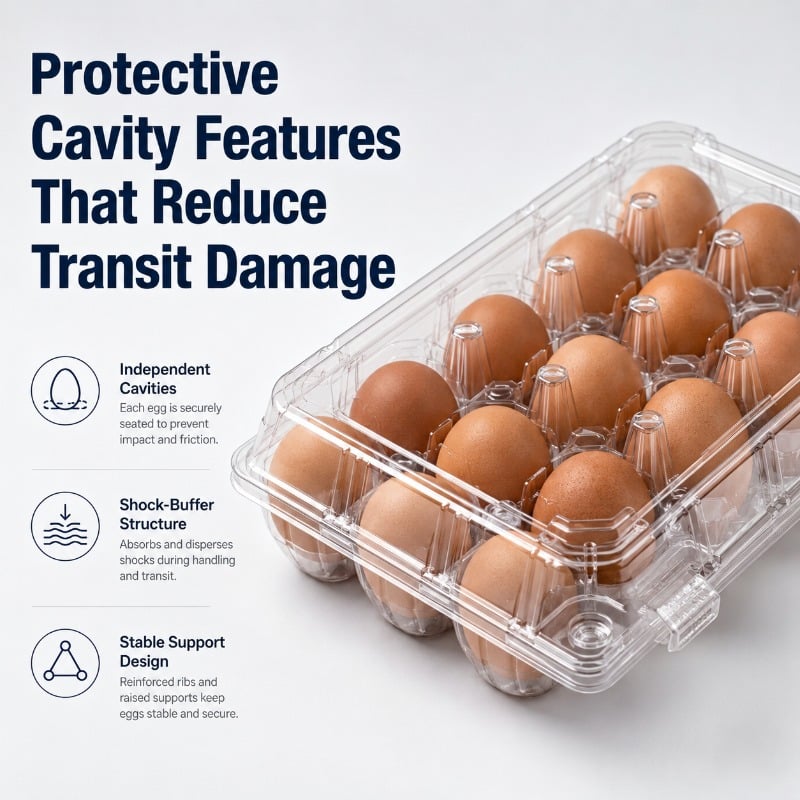
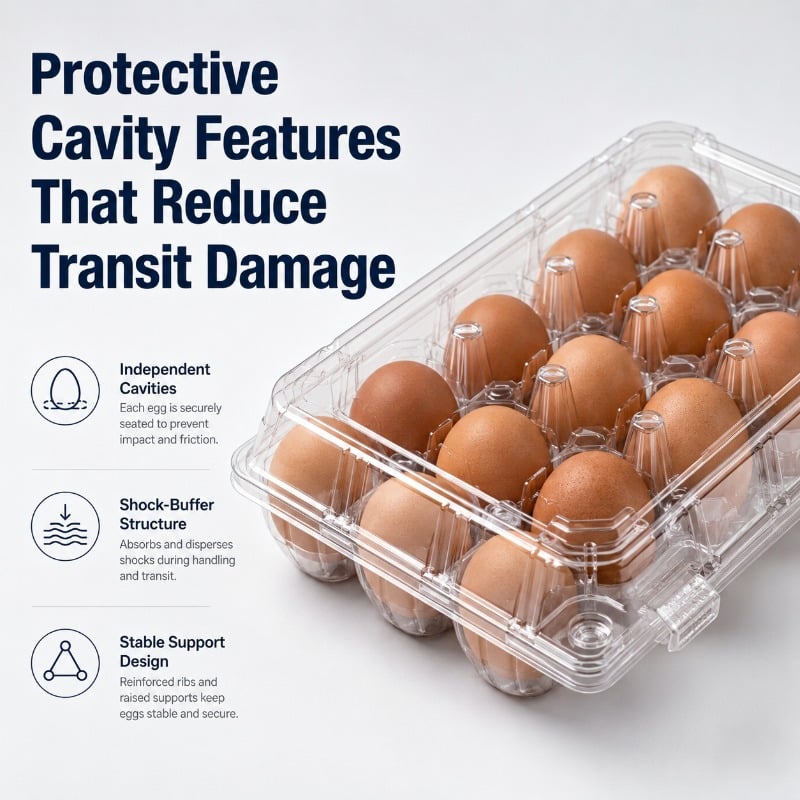
Protective Cavity Features That Reduce Transit Damage
The Role of Individual Egg Pockets in Vibration Isolation
Vibration damage is the silent accumulator in egg logistics. Even when no single shock is severe enough to crack a shell, the continuous low-amplitude vibration of road transport can cause eggs to rub against each other and against the cavity walls, gradually abrading the protective cuticle and creating stress concentrations that weaken the shell. Stackable PET egg packaging eliminates this wear mechanism through fully isolated cavities with high partition walls that prevent any possibility of egg-to-egg contact. Each egg sits in its own precisely contoured pocket, gripped gently around its equator by flexible ribs that dampen vibration without applying excessive pressure. The pocket geometry is designed to match the natural oval profile of the egg, distributing support across a broad contact area and eliminating the point loading that causes localized shell fatigue. Because stackable PET egg packaging retains its cavity shape regardless of humidity, the vibration damping performance that is verified in laboratory testing is the same performance that the eggs experience in the field. A shipment that travels for twelve hours on a rough rural road receives the same level of vibration protection as a shipment that travels on smooth highway, and the consistency of that protection is what allows logistics planners to predict damage rates with confidence and to set service level agreements with customers accordingly.
Integrated Shock Absorption and Anti-Slip Textures for Secure Handling
Beyond steady vibration, eggs must survive the sudden shocks of potholes, rail joints, and the occasional hard drop during manual handling. Stackable PET egg packaging incorporates dedicated energy-absorbing features beneath each cavity that compress during an impact to increase the deceleration distance and reduce the peak force transmitted to the egg. These crumple zones, which may take the form of tapered legs, arched supports, or flexible skirt structures, are molded directly into the PET tray and do not degrade after repeated impacts. Equally important is the anti-slip texture applied to the top and bottom contact surfaces of the tray. A subtle pattern of raised ribs or dimples increases the coefficient of friction between stacked layers, further resisting the lateral sliding that can misalign stacks and create concentrated loads. This texture also provides a more secure grip for manual handlers, reducing the chance of a tray slipping from gloved hands during loading and unloading. The combination of internal shock absorption and external anti-slip texture in stackable PET egg packaging creates a comprehensive protection system that addresses both the macro-level forces of pallet dynamics and the micro-level forces of individual handling events, ensuring that every egg reaches its destination in the condition that the packer intended.
Supply Chain Applications for Stackable PET Egg Packaging
From Farm to Grading Center: Minimizing Losses in Primary Transport
The first leg of the egg’s journey often takes place on farm roads that are unpaved, uneven, and subject to weather conditions that can turn a smooth path into a washboard overnight. Trays of eggs collected from the laying house are loaded onto trucks or trailers and transported to a central grading and packing facility, sometimes over distances of fifty kilometers or more. During this primary transport, the trays are typically stacked inside plastic crates or directly on the truck bed, and the vibration and shock loads can be severe. Stackable PET egg packaging designed with deep interlocking lugs and robust perimeter walls prevents the stacks from shifting even when the vehicle navigates rough terrain. The moisture resistance of PET is particularly valuable at this stage, because eggs fresh from the laying house may still carry residual warmth and humidity that would immediately begin to soften pulp trays. Stackable PET egg packaging remains dimensionally stable regardless of the conditions, ensuring that the eggs arrive at the grading center with the same protection they had when they left the farm. For large integrated operations where the farm and the grading center are separate entities, standardizing on stackable PET egg packaging for primary transport creates a uniform, predictable link in the chain that reduces disputes over responsibility for transit damage.
From Grading Center to Distribution Hub: Efficient Pallet Building and Long-Haul Stability
After washing, grading, and packing, the eggs embark on the longest and most logistically complex leg of their journey. At the grading center, filled trays must be stacked onto pallets quickly and accurately to keep pace with the packing line, and any tray design that is difficult to stack or that requires careful manual alignment will create a bottleneck. Stackable PET egg packaging with its self-aligning interlocking geometry enables operators to build pallets rapidly and with minimal training, because each tray naturally registers into the correct position on the layer below. Once the pallet is built and stretch-wrapped, it may travel hundreds of kilometers by truck to a regional distribution center, where it will be unloaded, scanned, and slotted into high-bay racking. The dimensional consistency of stackable PET egg packaging ensures that every pallet in a shipment occupies exactly the expected cube, simplifying warehouse slotting and reducing the labour associated with re-stacking shifted loads. Distribution center managers value stackable PET egg packaging because it allows them to store more eggs in the same square footage without increasing the risk of a pallet collapse that could injure workers or destroy product.
Supermarket and Retail Warehouse Storage: Maximizing Shelf Density and Order Picking Speed
When eggs reach the retail distribution network, space efficiency becomes paramount. Supermarket warehouses operate on razor-thin margins and every cubic meter of refrigerated storage must generate maximum revenue. Stackable PET egg packaging supports higher stacking configurations than pulp alternatives, enabling retailers to add one or two extra layers to each pallet position without compromising product integrity. This incremental density gain, multiplied across thousands of pallet positions per year, translates into measurable reductions in warehousing cost per unit sold. At the store level, stackable PET egg packaging also improves the efficiency of shelf replenishment. Because the trays interlock securely, a stock clerk can lift a full stack of four or five trays from a rolling rack and place them directly onto the refrigerated shelf without the stack separating or shifting. The transparency of PET further accelerates the stocking process by allowing the clerk to verify product condition and orientation at a glance, eliminating the need to open cartons or rotate individual trays. These time savings accumulate over the course of a shift, allowing store staff to spend more time on customer-facing activities that drive sales.
Export and Intermodal Logistics: Surviving Ocean Freight and Multi-Stop Distribution
International egg shipments subject packaging to the most extreme conditions in the logistics spectrum. A container loaded at an inland packing facility may travel by truck to a port, sit on the dock for days, spend weeks at sea with continuous engine vibration and humidity cycling, be unloaded at a destination port, clear customs, and then be distributed by truck or rail to multiple inland destinations. At every transfer point, the packaging is handled by different parties with different equipment and different levels of care. Stackable PET egg packaging is the preferred choice for export because its performance does not degrade with time or exposure. The moisture immunity of PET prevents the weakening that plagues pulp trays in the humid environment of an ocean container, and the interlocking stack geometry survives the repeated acceleration and deceleration of container handling equipment. Exporters who have transitioned to stackable PET egg packaging for their international lanes report fewer claims, faster customs clearance due to the professional presentation of the load, and stronger relationships with importers who appreciate receiving product that is ready for retail display without repacking.
Choosing the Right Stackable PET Egg Packaging for Your Operation
Aligning Tray Capacity, Material Gauge, and Cavity Size with Your Egg Profile
The protective performance of any stackable PET egg packaging begins with cavity fit. A tray designed for medium eggs will not safely hold extra-large or jumbo eggs, and a tray that is oversized for the egg will allow movement that increases impact risk. The first step in selecting the right stackable PET egg packaging is to measure a representative sample of eggs from the flock, recording the length and equatorial diameter, and to provide this data to the packaging manufacturer. The manufacturer can then recommend a cavity profile from its mold library that matches the egg dimensions with the appropriate grip and clearance. Material gauge, or wall thickness, is the next variable to consider. Heavier tray configurations for 24-egg and 30-egg formats require thicker walls and reinforced corner posts to support the increased load, while 12-egg retail trays can often achieve the required stack rating with a lighter gauge that reduces material cost and transport weight. A manufacturer with a comprehensive range of stackable PET egg packaging options can help the buyer navigate these trade-offs, ensuring that the selected specification provides the necessary protection without over-engineering and adding unnecessary expense.
Factoring in Transport Distance, Stack Height, and Outer Packaging Requirements
The logistics profile of the operation determines the performance threshold that the stackable PET egg packaging must meet. A farm that delivers eggs fifty kilometers to a single retail chain can accept a lower stack rating than an exporter shipping across an ocean. Buyers should provide the manufacturer with the maximum pallet stack height used in their warehouse, the longest transport duration the eggs will experience, and the type of outer packaging used, whether corrugated cases, reusable plastic crates, or direct pallet wrapping. With this information, the manufacturer can specify a stackable PET egg packaging design with load-bearing columns and interlocking features that are validated for the specific conditions of the route. Outer packaging compatibility is also critical: the tray footprint must fit snugly inside the master case to prevent lateral movement, and the case dimensions should be optimized for the container or truck cube to minimize freight cost per egg. An integrated approach that considers the tray, the outer case, and the pallet as a single system yields the best balance of protection, space efficiency, and delivered cost.
Launching Your Stackable PET Egg Packaging Improvement Project
Providing Your Logistics Specifications for a Tailored Recommendation
The most effective way to begin improving transport and warehouse efficiency with stackable PET egg packaging is to engage directly with a manufacturer that specializes in this category and has the mold inventory and engineering expertise to provide a precise fit. Share your average egg dimensions, your typical pallet configuration and stack height, your transport distances and modes, and any specific handling or storage conditions that are unique to your operation. A manufacturer with extensive experience in stackable PET egg packaging will analyze this information and return a detailed recommendation that includes the optimal tray capacity, cavity profile, material gauge, interlocking geometry, and outer carton specification. This recommendation will be supported by compression test data and, where relevant, container loading calculations that show exactly how the proposed packaging will perform in your logistics environment.
Conducting a Pilot Shipment to Validate Stacking Performance
Before committing to a full-scale rollout, run a pilot shipment using sample trays of the recommended stackable PET egg packaging. Build a pallet to your maximum stack height, load it onto your most demanding transport route, and inspect the condition of the eggs and the trays upon arrival. Measure any deformation of the bottom trays, check for any lateral shifting of layers, and document the breakage rate compared to your current packaging. This real-world validation converts the manufacturer’s engineering data into operational confidence, and it provides an opportunity to fine-tune the specification before the main order is placed. A packaging partner committed to your success will follow up after the trial to discuss findings and to make any adjustments needed to ensure that the stackable PET egg packaging delivers the logistics efficiency gains that your operation requires.
Frequently Asked Questions About Stackable PET Egg Packaging
The maximum number of layers that can be safely stacked using stackable PET egg packaging
The safe stacking height depends on the specific tray design, the material gauge, and the egg size being packed. Most properly engineered stackable PET egg packaging can support ten to twelve layers in a refrigerated warehouse environment without transferring weight to the eggs in the bottom trays. The manufacturer provides a rated stack height based on compression testing conducted at the temperature and humidity conditions that match the intended storage environment. Buyers should never exceed this rated height, as doing so risks cavity deformation and pressure cracking that may not be visible until the consumer opens the carton. For operations that require exceptionally tall stacking, reinforced tray designs with thicker corner posts and additional load-bearing columns are available and should be specified at the procurement stage.
The difference in container utilization between stackable PET egg packaging and molded pulp trays
Stackable PET egg packaging generally enables higher container utilization than molded pulp for two reasons. First, because PET trays maintain dimensional stability in humid conditions, pallets can be built to a greater height without the safety margin required for pulp, which weakens during transit. Second, the consistent dimensions of injection-molded PET trays allow for tighter pallet patterns and more precise container stuffing plans, reducing wasted space. Exporters who switch from pulp to stackable PET egg packaging often find that they can load five to ten percent more eggs per container, a gain that directly improves the landed cost per egg and strengthens their competitive position in the destination market.
The compatibility of stackable PET egg packaging with automated packing and palletizing equipment
Stackable PET egg packaging is produced to tight dimensional tolerances that make it highly compatible with automated denesting, filling, and palletizing systems. The consistent tray weight and the precise location of interlocking features enable robotic handling equipment to pick and place trays reliably without the jams and misplacements that can occur with dimensionally variable pulp trays. The smooth, flat surfaces of PET trays also interact predictably with conveyor belts, sensors, and stretch-wrapping machinery. For operations that are investing in packing line automation, standardizing on stackable PET egg packaging reduces the integration complexity and increases the overall equipment effectiveness of the automated system.
The environmental considerations when choosing stackable PET egg packaging for logistics efficiency
Stackable PET egg packaging contributes to environmental performance through several pathways. The higher stacking density and better container utilization reduce the number of truck trips and container shipments required to move a given volume of eggs, directly lowering the carbon footprint of distribution. The durability of PET allows trays to be reused multiple times in closed-loop systems, further reducing material consumption per egg delivered. At the end of its service life, PET is fully recyclable in established bottle and thermoform recovery streams and can be processed into new trays with a high percentage of post-consumer content. These factors combine to make stackable PET egg packaging a choice that supports both operational efficiency and sustainability objectives.
Share your stacking height and shipping route to choose the right tray structure.
Table of Contents
- The Critical Role of Packaging Geometry in Transport and Storage Efficiency
- Structural Principles of Stackable PET Egg Packaging
- Protective Cavity Features That Reduce Transit Damage
-
Supply Chain Applications for Stackable PET Egg Packaging
- From Farm to Grading Center: Minimizing Losses in Primary Transport
- From Grading Center to Distribution Hub: Efficient Pallet Building and Long-Haul Stability
- Supermarket and Retail Warehouse Storage: Maximizing Shelf Density and Order Picking Speed
- Export and Intermodal Logistics: Surviving Ocean Freight and Multi-Stop Distribution
- Choosing the Right Stackable PET Egg Packaging for Your Operation
- Launching Your Stackable PET Egg Packaging Improvement Project
-
Frequently Asked Questions About Stackable PET Egg Packaging
- The maximum number of layers that can be safely stacked using stackable PET egg packaging
- The difference in container utilization between stackable PET egg packaging and molded pulp trays
- The compatibility of stackable PET egg packaging with automated packing and palletizing equipment
- The environmental considerations when choosing stackable PET egg packaging for logistics efficiency
- Share your stacking height and shipping route to choose the right tray structure.