 EN
EN

The Specialized Requirements of International Egg Logistics
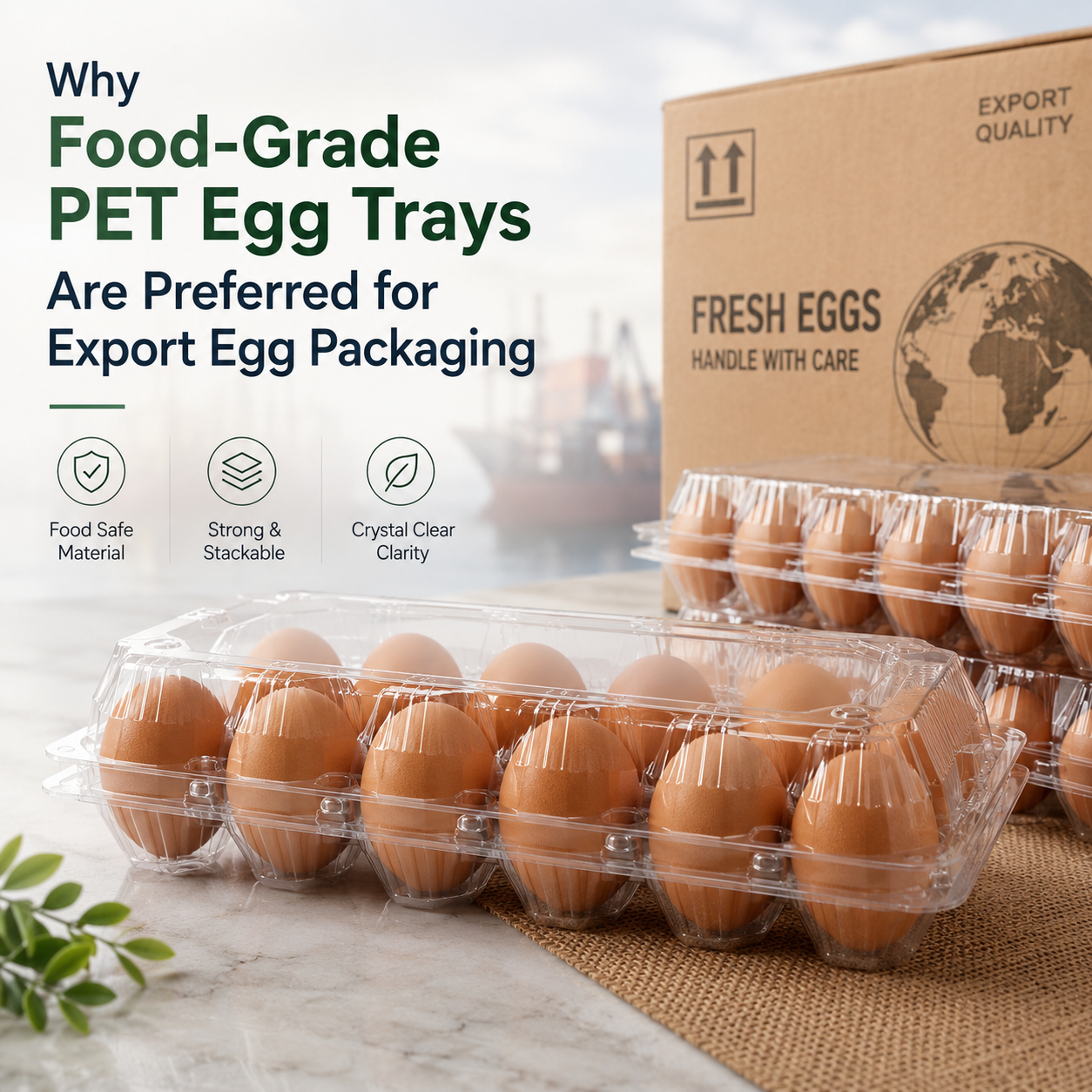
Exporting eggs across international borders introduces a layer of complexity that domestic distribution never encounters. A shipment that leaves the packing facility in perfect condition can arrive at an overseas retail shelf weeks later with invisible structural damage that only becomes apparent when the consumer opens the carton. The packaging selected for export must simultaneously satisfy multiple, often conflicting demands: it must be manufactured from materials certified for direct food contact by the regulatory agencies of both the exporting and importing countries, it must maintain its mechanical integrity through humidity swings and temperature fluctuations that would destroy absorbent materials, it must protect the eggs from the cumulative vibration and shock of ocean and road transport, and it must present the product attractively on a foreign retail shelf where brand recognition is being built from zero. Food-grade PET egg trays have become the preferred solution for export-oriented poultry operations precisely because they address every one of these demands within a single, verifiable material platform. Why do export managers increasingly specify food-grade PET egg trays as a non-negotiable requirement in their packaging procurement? The answer lies in the material’s unique combination of certified safety, structural predictability, and resistance to the environmental stresses that define long-haul international logistics. When a container of eggs spends three weeks at sea, passes through two different climate zones, and is then distributed through a cold chain that may not be perfectly maintained at every handoff, the packaging is the only thing standing between the product and a costly rejection. Food-grade PET egg trays provide that protection with a consistency that makes export planning a matter of engineering rather than a gamble.
The Material Advantages of Food-Grade PET Egg Trays
Guaranteed Food Contact Safety Across Regulatory Regimes
Every country that imports eggs maintains its own set of standards governing materials that come into direct contact with food. The European Union enforces stringent migration limits under its plastic food contact material regulations, the United States FDA maintains its own positive list of acceptable substances, and markets in the Middle East and Asia increasingly require documentation aligned with these international benchmarks. Food-grade PET egg trays manufactured from virgin or certified recycled PET resin meet the requirements of these major regulatory frameworks, and a responsible manufacturer provides a complete documentation package that includes statements of compliance, third-party laboratory test reports, and batch-level traceability linking the finished tray back to the original resin lot. Why is this certification critical for export? A container held at a port of entry because the packaging lacks proper food contact documentation incurs demurrage charges, spoilage risk, and relationship damage with the importer that can take years to repair. Food-grade PET egg trays eliminate this risk at its source by using only resin that has been verified free of heavy metals, phthalates, bisphenol compounds, and other substances of concern. The certification is not simply a paper exercise; it represents a material choice that begins at the resin supplier and is validated at every stage of production, providing export managers with the confidence that their packaging will clear customs without delay and present no risk to consumer health in the destination market.
Total Moisture Immunity in High-Humidity Transport Environments
Eggs are shipped under refrigeration, and refrigerated environments generate condensation. When a container moves from a tropical loading port into the cool hold of a vessel, and then emerges again into warm, humid air at the destination, the humidity inside the container can fluctuate dramatically. Absorbent packaging materials such as molded pulp respond to these fluctuations by taking up moisture from the air, swelling, and losing a substantial portion of their compressive strength. A pulp tray that was structurally sound at the packing shed can become dangerously soft after ten days at sea, allowing the lower layers of a pallet to collapse and crack the eggs they were meant to protect. Food-grade PET egg trays are completely impervious to moisture. They do not absorb water, they do not swell, and their mechanical properties remain unchanged whether the relative humidity is ten percent or one hundred percent. This moisture immunity means that the pallet configuration calculated to be safe at the origin remains equally safe throughout the entire voyage and the subsequent distribution cycle in the destination country. For export shipments where the packaging may be the last line of defense for weeks on end, the dimensional stability of food-grade PET egg trays under all humidity conditions is a decisive performance advantage that translates directly into lower claim rates and higher customer satisfaction.
Predictable Mechanical Performance Under Stacking and Shock Loads
Long-distance export logistics subjects packaging to sustained static loads from tall pallet stacks in warehouses and container stuffing, as well as dynamic shock loads from vessel movement, road vibration, and multiple handling transfers at ports and distribution centers. The injection molding process used to produce food-grade PET egg trays allows for the precise replication of engineered protective features: energy-absorbing crumple columns beneath each cavity, flexible support skirts that cradle the egg without concentrating pressure, and vertical load-bearing pillars that transfer the weight of upper layers directly through the tray structure rather than through the eggs themselves. Because these features are molded into the tray with high precision and do not degrade when exposed to moisture, a pallet of food-grade PET egg trays performs consistently from origin to final destination. In contrast, cushioning materials that rely on fibrous compression can pack down permanently after an initial impact, leaving the eggs less protected against subsequent shocks. The repeatable resilience of food-grade PET egg trays is particularly valuable in intermodal export chains where the shipment may be handled by multiple parties, each introducing its own set of mechanical stresses. The packaging buyer who chooses food-grade PET egg trays for export is investing in a known, testable level of protection that does not degrade as the journey progresses.
Navigating the Complete Export Logistics Chain
Pre-Shipment Warehousing and Container Loading Integrity
The export journey begins long before the container doors close. Pallets of packed eggs may sit in a cold storage warehouse for days while the shipment is consolidated, and the bottom trays in each stack must bear the cumulative weight throughout this holding period. Food-grade PET egg trays with interlocking stacking lugs prevent layer shifting during forklift movement and container loading, maintaining the perfect vertical alignment that keeps loads distributed safely through the tray walls. When a container is stuffed, the pallets are often loaded with minimal clearance, and any dimensional variability in the packaging can cause binding, crushing, or load shift during the initial stages of transit. The dimensional consistency of injection-molded food-grade PET egg trays ensures that every carton and every layer occupies exactly the expected volume, allowing logistics planners to maximize container cube utilization without compromising load stability. This precision in loading density directly affects the landed cost per egg, a critical metric in the thin-margin world of international commodity trade. Exporters who standardize on food-grade PET egg trays can confidently build loading plans that squeeze every cubic meter of value from the container while maintaining the structural safety margins verified through compression testing.
Ocean Freight and Intermodal Handling Stresses
A container vessel at sea is a continuously vibrating environment, with engine harmonics and wave action combining to create a low-frequency hum that persists for the entire duration of the voyage. This vibration can cause poorly nested trays to walk across each other, eventually cantilevering out of alignment and placing concentrated loads on the rims of eggshells. Food-grade PET egg trays with positive-lock interlocking features resist this migration, holding the stack in a monolithic column that moves as a single unit. When the container is offloaded and transferred to a truck or railcar for inland distribution, the shocks become more acute: potholes, rail joints, and docking bumps deliver short-duration, high-amplitude impacts that test the energy-absorbing capacity of the packaging. The engineered crumple zones and flexible cavity walls of food-grade PET egg trays convert these shock pulses into harmless elastic deformation, protecting the eggs from the peak forces that cause shell fracture. Have you ever considered how many individual impact events an export egg endures before reaching the consumer? In a multi-leg international journey, the number can easily exceed several dozen distinct handling and transport shocks, each one a potential failure point if the packaging has already been weakened by moisture or permanent compression. Food-grade PET egg trays maintain their protective performance through every one of these events, providing cumulative protection rather than degrading protection.
Destination Market Distribution and Retail Presentation
Once the container clears customs and enters the importing country’s distribution network, the packaging faces a new set of demands. The eggs may be re-palletized, broken down into smaller lots, and delivered to retail locations using vehicles and handling practices that differ from those at the origin. Throughout this process, the clarity of food-grade PET egg trays becomes a significant asset. Importers and retailers can inspect the eggs for cracks, cleanliness, and grade conformity without opening the sealed carton, accelerating quality assurance checks and reducing the handling that itself can cause damage. At the retail shelf, the transparency of food-grade PET egg trays allows the eggs to serve as their own visual sales pitch. A foreign consumer encountering the brand for the first time can see the shell color, uniformity, and integrity directly, building the trust that leads to trial purchase. For exporters investing in brand building in new markets, food-grade PET egg trays provide a consistent, premium presentation that communicates quality without requiring the consumer to read the label language. The packaging that protected the eggs across an ocean now works as a silent brand ambassador on a retail shelf thousands of miles from the farm.
Essential Export Packaging Verification Points
Material Certification and Regulatory Documentation
Before a single tray is loaded with eggs for export, the buyer must verify that the packaging meets the food contact regulations of the destination country. The verification process for food-grade PET egg trays begins with requesting the manufacturer’s material safety data sheets, statements of compliance for the relevant regulatory frameworks, and third-party laboratory test reports from ISO 17025 accredited facilities. The documentation should cover migration testing performed on the finished tray, not just on the raw resin, because the molding process can affect the final material properties. Buyers should also confirm that the food-grade PET egg trays are manufactured in a facility that maintains food safety management system certification, which provides additional assurance that production hygiene, contamination controls, and traceability procedures meet international expectations. A complete documentation package submitted in advance to the importer or customs broker prevents clearance delays and establishes the exporter as a professional, reliable supplier whose shipments are unlikely to encounter regulatory complications.
Structural and Dimensional Verification
Export packaging must be validated not just on paper but through physical testing that replicates the conditions of the intended shipping route. The key structural checks for food-grade PET egg trays include compression testing at the maximum expected stack height under refrigerated conditions, drop testing at the temperature and humidity profile of the sea voyage, and vibration testing that simulates the duration and frequency spectrum of ocean transport. Buyers should request the manufacturer’s test reports or, better yet, commission their own testing using sample trays packed with actual eggs. Dimensional verification ensures that the tray footprint aligns with the internal dimensions of the master carton or reusable crate, that the interlocking features engage securely without excessive force, and that the cavity dimensions match the egg size distribution of the flock. Any mismatch in these dimensions can create movement or pressure that multiplies breakage during transit. Food-grade PET egg trays that pass these structural and dimensional checks provide the exporter with documented confidence that the packaging will perform as required.
Labeling, Traceability, and Container Optimization
Export shipments require legible, durable labeling that remains intact and scannable throughout the journey. The smooth surfaces of food-grade PET egg trays accept pressure-sensitive labels that resist peeling in refrigerated humidity, and they can be supplied with pre-applied labels carrying the importer’s required information, including sell-by dates, lot codes, country of origin, and barcodes. Direct inkjet coding onto designated printable areas of the tray eliminates separate label application for variable data, streamlining the packing process and reducing errors. Traceability is another critical export requirement: food-grade PET egg trays coded with GS1-compliant barcodes and QR codes enable rapid lot-level tracking from the packing shed to the retail checkout, supporting efficient recalls and inventory management. Finally, container optimization analysis ensures that the chosen tray dimensions and outer carton configuration maximize the number of eggs shipped per container while maintaining safe stacking loads. A manufacturer experienced in export packaging can provide loading plans and palletization diagrams that help the exporter calculate freight costs accurately and achieve the lowest possible landed cost per tray.
Product Architecture Designed for Export-Grade Performance
Individually Isolated Cavities and Integrated Shock Protection
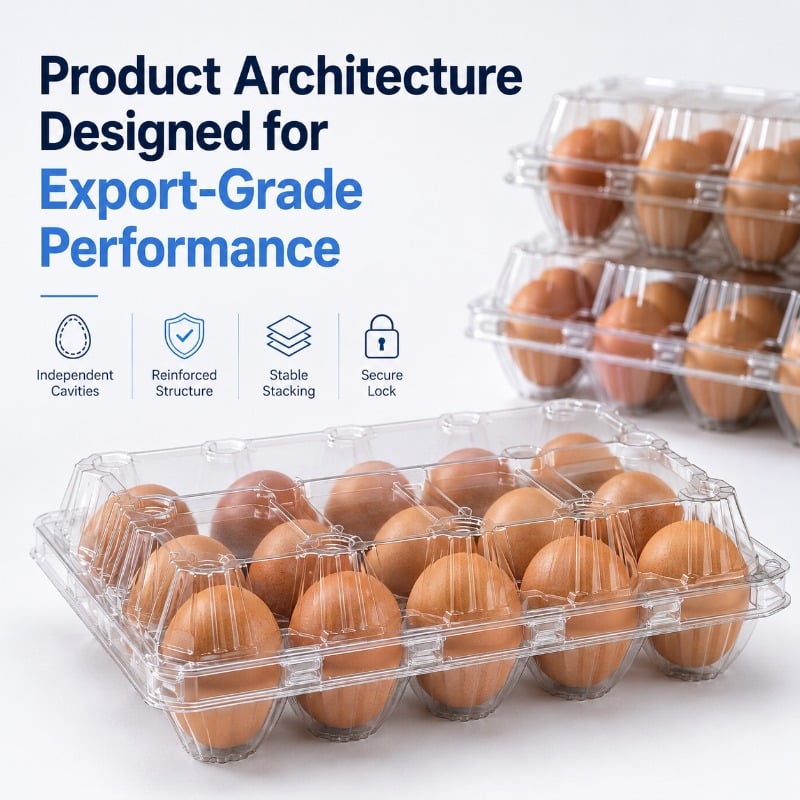
The fundamental protective unit of any egg tray is the individual cavity, and in food-grade PET egg trays designed for export, every cavity functions as a self-contained protective cell. Full-height partition walls separate each egg from its neighbors, eliminating the egg-to-egg contact that transmits impact fractures across multiple shells during a drop event. Inside each cavity, the egg rests on a contoured support surface that distributes its weight evenly around the equator, avoiding the point loading that creates star cracks. Below each cavity, molded shock-absorbing structures such as tapered columns or arched supports compress under impact, increasing the deceleration distance and reducing the peak force experienced by the egg. Because food-grade PET egg trays are injection molded, these protective geometries are created with high precision and repeated identically across every cavity in every tray, providing uniform protection that can be characterized through laboratory testing and relied upon in logistics planning. The result is a packaging system where the protective performance of tray number ten thousand is identical to that of tray number one, a consistency that export buyers depend on when committing to multi-container programs.
Secure Closure and Tamper-Evident Features
A carton that opens during transit loses all protective value and creates a mess that can soil surrounding packages and attract regulatory scrutiny at the destination. Food-grade PET egg trays incorporate positive-locking closure mechanisms that produce an audible click when properly engaged, giving packing line operators and quality inspectors a simple, reliable confirmation that the carton is securely closed. For high-value export shipments or markets with stringent food safety expectations, tamper-evident features can be integrated into the closure design. These features, which may include breakaway tabs or irreversible locking indicators, provide visible proof that a carton has not been opened since it left the packing facility. The combination of secure closure and optional tamper evidence in food-grade PET egg trays protects the exporter against claims of tampering or contamination that could otherwise become costly disputes with no clear resolution. This level of security is particularly valued in export channels where the shipment changes custody multiple times and the original packer has no control over intermediate handling.
Optimized Stacking Geometry and Label-Ready Surfaces
Export pallets are built high to maximize container utilization, and the stacking geometry of the tray must support this without allowing layers to shift or tip. Food-grade PET egg trays are designed with interlocking top and bottom surfaces that register each tray precisely onto the one below, creating a stable, self-aligning stack that resists the lateral forces of forklift movement and vessel motion. The stacking lugs are engineered to carry the full weight of the layers above without transferring any load to the eggs, a critical design requirement that must be verified through compression testing. The top surface of the tray also incorporates flat, smooth label panels strategically positioned to carry branding, regulatory, and traceability information without obscuring the transparent window through which the eggs are displayed. This thoughtful allocation of surface area ensures that food-grade PET egg trays serve equally well as protective transport packaging and as retail-ready presentation packaging, eliminating the need for repacking at the destination and reducing the labor and material costs that would otherwise erode the exporter’s margin.
Beginning Your Export Packaging Assessment
Providing Destination and Volume Information for a Tailored Recommendation
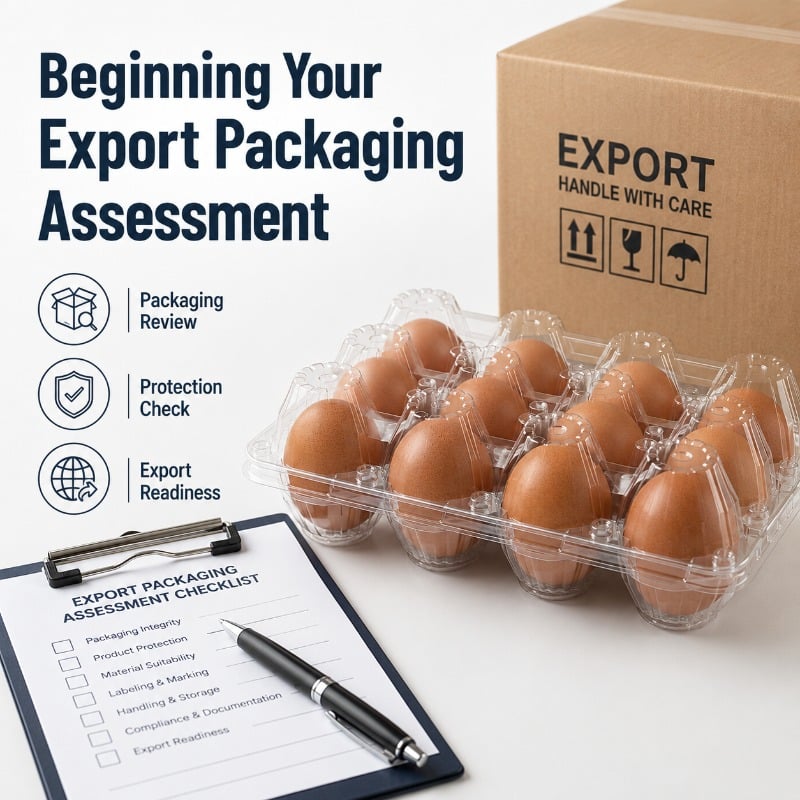
The first step toward an optimized export packaging program using food-grade PET egg trays is to share the key parameters of your shipment profile with a qualified manufacturer. Specify the destination country or countries, the regulatory frameworks that apply, the average weight and dimensional range of the eggs being exported, the desired tray capacity, and the typical order volume and shipping frequency. Include details about the transport mode, whether sea freight, air freight, or a combination, and any specific handling or storage conditions that are known. The more complete the initial information package, the more precisely the manufacturer can recommend a food-grade PET egg trays configuration that matches the export lane’s specific demands. This collaborative approach ensures that the packaging is not over-engineered for the risk level, which adds unnecessary cost, nor under-engineered, which invites damage claims.
Receiving a Comprehensive Export Packaging Proposal
Upon reviewing the provided information, an experienced manufacturer of food-grade PET egg trays will prepare a detailed proposal that covers the recommended tray specification, cavity profile justification, material certification package for the destination market, container loading optimization calculations, labeling and coding solutions, and a transparent cost breakdown. The proposal will also include a production and delivery timeline aligned with the exporter’s shipping schedule, and an offer of sample trays for pre-shipment testing and validation. Armed with this proposal, the export manager can make a confident, data-backed decision that protects the product, satisfies the regulatory requirements of the target market, and presents the brand with the quality and consistency that builds long-term importer relationships.
Frequently Asked Questions About Food-Grade PET Egg Trays for Export
The documentation required to prove that food-grade PET egg trays comply with destination market food contact regulations
Exporters should obtain from their packaging supplier a complete compliance dossier that includes a statement of conformity to the relevant food contact regulation, a third-party migration test report from an ISO 17025 accredited laboratory performed on the finished tray, and a batch-level traceability record linking the production lot to the specific resin shipment used. For EU destinations, this documentation must align with Regulation (EU) No 10/2011 on plastic materials intended to come into contact with food. For US-bound shipments, FDA 21 CFR compliance documentation is required. Additional markets may require specific certificates, and an experienced exporter of food-grade PET egg trays will be familiar with the documentation package needed for each region. The key is to request and review this documentation before the shipment is produced, not after it is en route, so that any gaps can be addressed without delaying customs clearance.
The suitability of food-grade PET egg trays for air freight versus sea freight export modes
Food-grade PET egg trays perform exceptionally well in both air and sea freight environments, but the requirements differ slightly. Air freight involves rapid pressure changes during ascent and descent, and vented tray designs that allow pressure equalization without admitting contaminants become important. The low-pressure environment of an aircraft cargo hold can cause sealed packages to expand, and food-grade PET egg trays with appropriately designed closures and vent paths manage this without opening or distorting. Sea freight presents prolonged humidity exposure and sustained vibration, which is where the moisture immunity and dimensional stability of food-grade PET egg trays become decisive advantages. In both modes, the consistent mechanical properties of PET across temperature and humidity ranges make it a reliable choice, and a manufacturer can recommend minor design adjustments to optimize performance for the specific transport mode being used.
The breakage rate difference typically observed when switching from pulp to food-grade PET egg trays for export
Exporters who transition from molded pulp to food-grade PET egg trays for their international shipments consistently report a measurable reduction in breakage claims. The improvement is most pronounced on longer routes with multiple handling points and in destinations with humid climates, where pulp trays progressively lose strength during transit. While the exact reduction depends on the shipping lane, the stack height, and the egg size, it is common to see claim rates drop by more than half after the switch. Beyond the direct savings in product replacement and credit processing, exporters also benefit from strengthened relationships with importers who appreciate receiving consistently intact product and who may be willing to pay a premium for the reliability that food-grade PET egg trays provide.
The labeling and traceability capabilities that food-grade PET egg trays support for international markets
Food-grade PET egg trays can be supplied with pre-applied pressure-sensitive labels in the language of the destination market, carrying the importer’s brand, nutritional panels, country of origin markings, and any certification logos required for that market. Direct inkjet coding onto a prepared surface area of the tray provides variable data such as production date, expiration date, and lot number without additional label application steps. QR codes printed on the tray can link to farm traceability portals that allow consumers or regulators to view the complete journey of the eggs, a feature increasingly valued in premium export channels. The integration of labeling and traceability into food-grade PET egg trays ensures that every carton arriving at the destination retail shelf is fully compliant, correctly coded, and ready for immediate sale, reducing the labor and complexity typically associated with export packaging programs.
Why Food-Grade PET Egg Trays Are Preferred for Export Egg Packaging
Table of Contents
- The Specialized Requirements of International Egg Logistics
- The Material Advantages of Food-Grade PET Egg Trays
- Navigating the Complete Export Logistics Chain
- Essential Export Packaging Verification Points
- Product Architecture Designed for Export-Grade Performance
- Beginning Your Export Packaging Assessment
-
Frequently Asked Questions About Food-Grade PET Egg Trays for Export
- The documentation required to prove that food-grade PET egg trays comply with destination market food contact regulations
- The suitability of food-grade PET egg trays for air freight versus sea freight export modes
- The breakage rate difference typically observed when switching from pulp to food-grade PET egg trays for export
- The labeling and traceability capabilities that food-grade PET egg trays support for international markets
- Why Food-Grade PET Egg Trays Are Preferred for Export Egg Packaging