 EN
EN

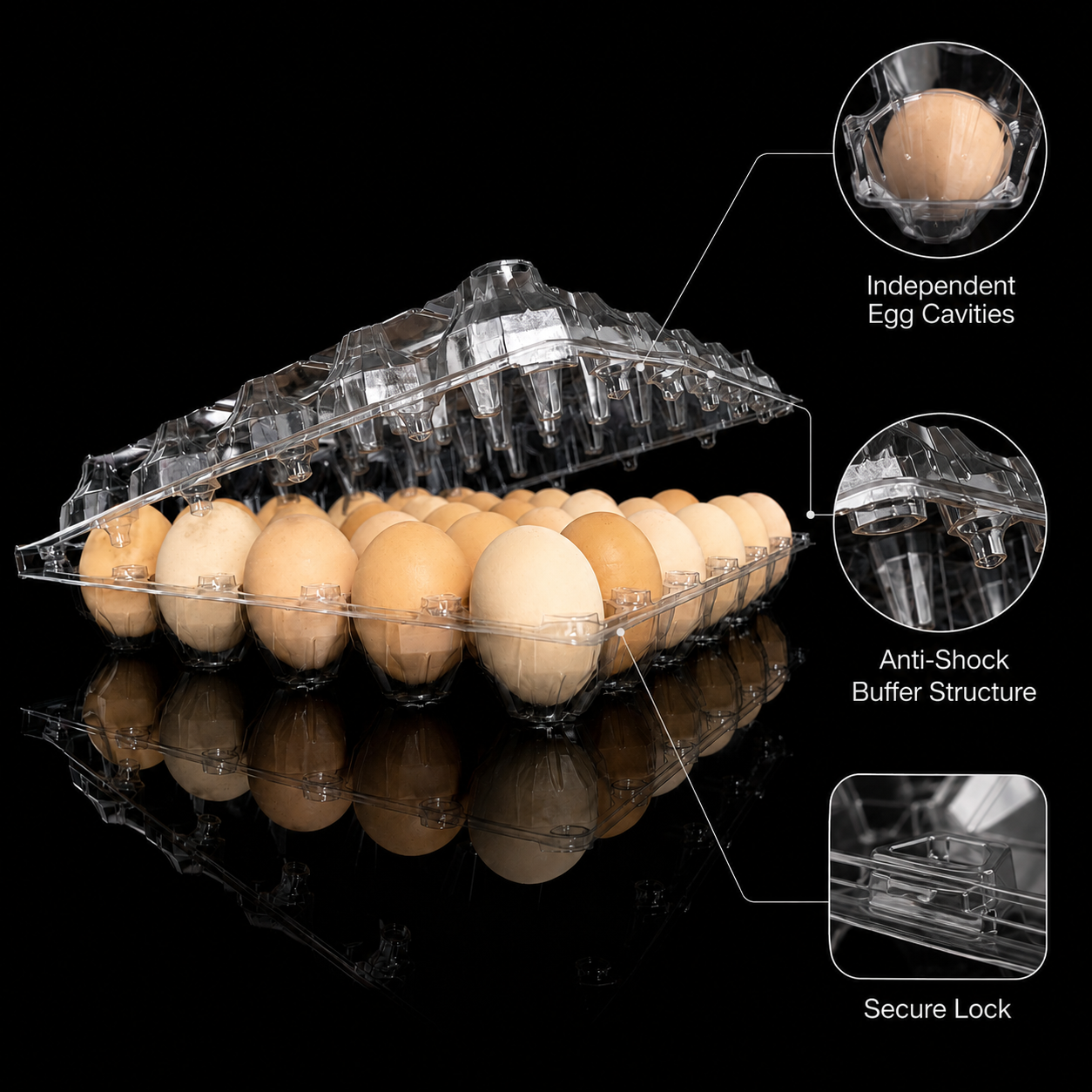
Why Closure Design Matters
A carton's ability to protect its contents starts with how it closes, not just what it's made of. Egg carton locking design determines whether a carton stays sealed through handling, stacking, and transit, or whether it pops open at the worst possible moment. For PET egg cartons specifically, closure engineering carries more weight than material choice alone, since the rigid, molded structure relies entirely on the lock mechanism to hold the two halves together.
Buyers often focus on carton thickness or clarity when evaluating quality, but a secure egg carton lock is what actually determines real-world performance on the packing line and beyond. A well-engineered egg carton locking design reduces manual packing errors, prevents accidental reopening, and keeps the carton reliably shut without requiring excessive force from packing staff.
Common PET Egg Carton Locking Structures
PET egg cartons typically use one of a few closure approaches, each with different tradeoffs in strength, ease of use, and manufacturing cost.
Tab-and-Slot Closures
This is a simpler mechanism where a molded tab inserts into a corresponding slot. It's low-cost to produce but can loosen with repeated opening and closing, making it less suited to high-frequency retail handling.
Friction-Fit Clamshell Edges
Common in basic clamshell egg carton design, this method relies on the carton's molded edge tension to hold the lid closed. It works for light handling but offers minimal resistance against pressure from stacking or rough transit.
Hook-Shaped Locking Structures
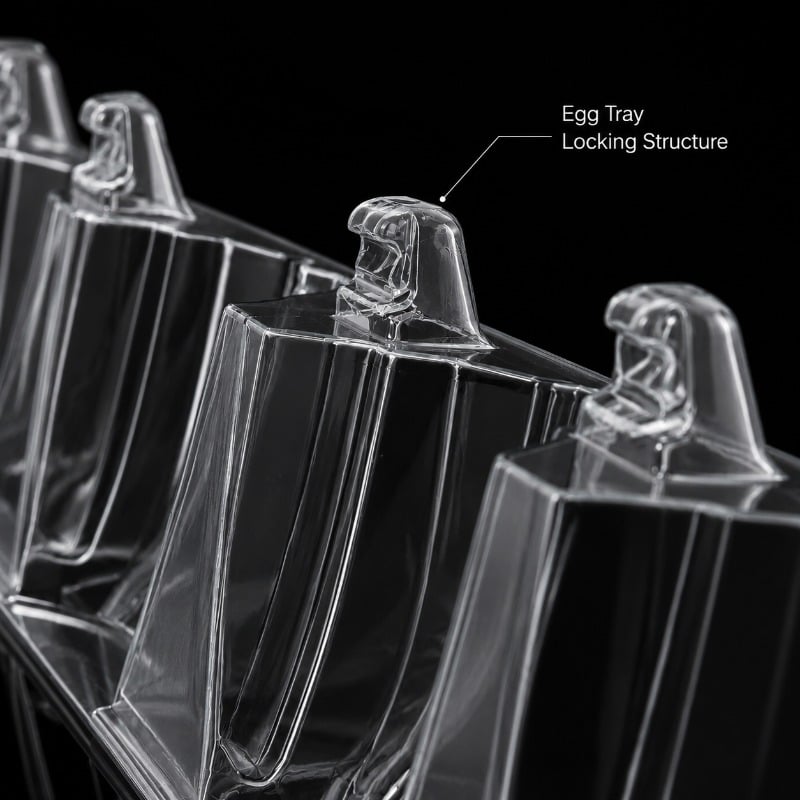
A more advanced approach to egg carton locking design uses a curved, hook-shaped tab that clicks into a matching recess, creating a mechanical interlock rather than relying on friction alone. This is the structure used in our current PET egg carton closure system, described in detail below.
| Locking Type | Closure Strength | Reopening Risk | Best Use Case |
|---|---|---|---|
| Tab-and-slot | Low to Moderate | Higher after repeated use | Light-duty, single-use packs |
| Friction-fit clamshell | Low | Moderate | Basic retail display |
| Hook-shaped lock | High | Low | Retail + transit handling |
Hook-Shaped Locks and Easy-Click Closures
Our Secure Hook-Shaped Lock is designed around a simple mechanical principle: the closing tab curves inward slightly before terminating in a small hooked edge, which catches against a matching ridge molded into the carton base. When the lid is pressed down, the hook flexes briefly, then snaps into place behind the ridge — producing an audible click that confirms full closure.
Detail of the Lock Engagement
Zooming into the closure point, the hook tip sits roughly 2mm behind the retaining ridge once engaged, leaving very little clearance for the tab to slip back out under normal pressure. This small engagement depth is intentional — it's enough to resist upward or lateral force from stacking, but shallow enough that the carton can still be opened deliberately with a firm, controlled pull.
Step-by-Step Closure Process
- Align the lid tab with the base slot, keeping the carton flat.
- Press down at the tab location until slight resistance is felt.
- Continue pressure until the hook clicks past the retaining ridge.
- Confirm closure by gently pulling upward on the lid edge — a properly locked carton will not separate.
This four-step motion is consistent whether closure is done by hand on a packing line or verified during quality testing of the egg carton locking design.
Lock Strength vs Packing Speed
A common concern among buyers is whether a stronger lock slows down manual packing. In practice, the hook-shaped design is tuned to balance both factors rather than maximizing strength alone.
Comparing Closure Effort Across Lock Types
| Factor | Tab-and-Slot | Friction-Fit | Hook-Shaped Lock |
|---|---|---|---|
| Force needed to close | Low | Low | Moderate |
| Accidental reopening risk | Higher | Higher | Low |
| Packing speed (manual) | Fast | Fast | Fast, single motion |
| Consistency across units | Variable | Variable | Consistent click feedback |
The single-motion click of the hook-shaped lock means packing staff don't need to double-check closure visually — the audible and tactile feedback confirms it, which actually reduces time spent on quality checks during high-volume packing runs.
How Lock Design Affects Transport Handling
While closure engineering is the core focus of carton design, transport is where a weak lock's consequences become visible. A carton that separates under stacking pressure or vibration during transit isn't failing because of the shipping process itself — it's failing because the egg carton locking design wasn't sufficient to hold under sustained mechanical stress.
The hook-shaped lock's mechanical interlock is specifically built to resist the kind of repeated micro-movement that occurs during palletized transport, where cartons shift slightly against each other over long distances. Because the hook engages behind a fixed ridge rather than relying on surface friction, it maintains closure integrity even as external pressure fluctuates.
Questions Buyers Should Ask Suppliers
Before selecting a PET egg carton closure system, buyers should confirm the following with their supplier:
| Question to Ask | Why It Matters |
|---|---|
| What type of locking structure is used? | Determines baseline security and reopening risk |
| Has the lock been tested under stacking load? | Confirms real-world durability |
| Does the closure work with automated packing lines? | Impacts production line compatibility |
| What is the reopening force required? | Balances security with ease of intentional access |
| Is the lock design consistent across carton sizes? | Ensures uniform performance across product lines |
FAQ
What makes an egg carton lock secure?
A secure lock relies on mechanical interlocking rather than friction alone. Hook-shaped structures that catch behind a fixed ridge offer stronger resistance to accidental opening than simple tab-and-slot or friction-fit designs.
Can stronger locks slow down packing?
Not necessarily. A well-tuned hook-shaped lock closes in a single motion with clear tactile and audible feedback, which can actually speed up packing by removing the need for manual closure checks.
Are PET locks suitable for automated packing?
Yes, hook-shaped locking structures are generally compatible with automated packing lines, provided the closure force is calibrated to work with mechanical pressing equipment rather than manual hand pressure alone.
How should buyers test closure strength?
Buyers can test closure strength by applying upward pull force after locking, checking for separation under simulated stacking weight, and confirming consistent engagement across multiple units from the same production batch.