 EN
EN

Packaging Decisions That Directly Impact Your Bottom Line
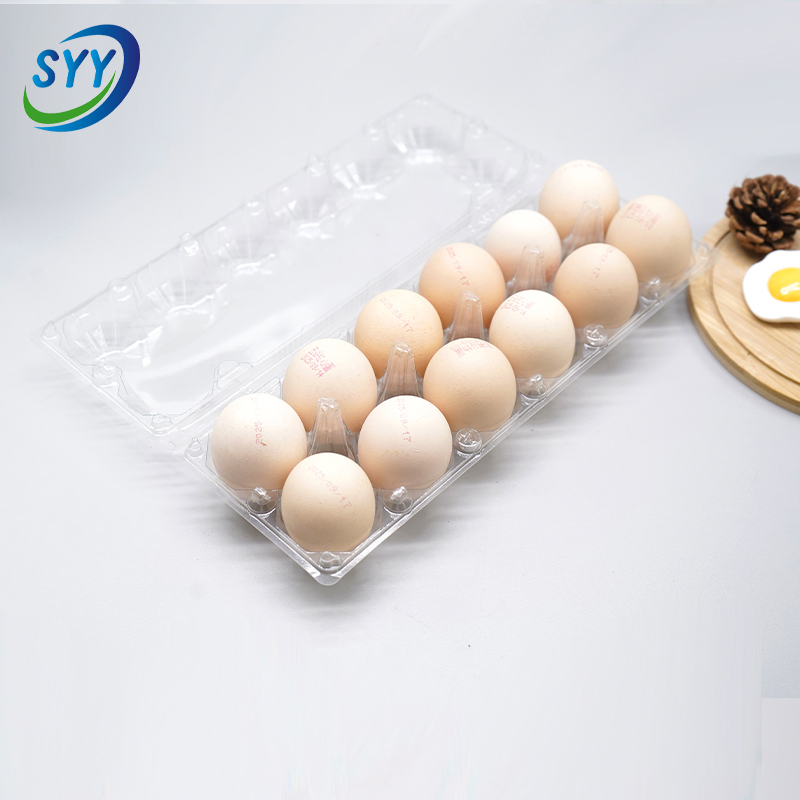
Every poultry farm manager understands that the journey from the laying house to the customer’s kitchen is filled with risk. A single hairline crack on an egg can mean a lost sale, a disappointed wholesale buyer, or a damaging online review that drives future customers away. When a farm evaluates its operational costs, packaging might seem like a simple commodity purchase, yet the choice of egg tray directly shapes breakage rates, transport efficiency, and the frequency of customer complaints. Shifting from conventional materials to PET egg packaging for poultry farms is not merely a material upgrade; it is a strategic move that reshapes how a brand is perceived in the marketplace.
Have you ever calculated the true cost of replacing broken eggs after a long delivery route? Those losses extend beyond the value of the individual egg. They include the labor spent repacking, the administrative time processing credits, and the subtle erosion of trust that happens when a retailer opens a case and finds sticky, cracked shells. For many operations, a change to high-clarity, precision-molded PET egg packaging for poultry farms reduces those hidden costs substantially. The packaging becomes a silent quality assurance tool, allowing handlers and buyers to inspect eggs without touching them, thereby cutting down on additional handling damage.
Why do some trays collapse when stacked six or seven layers high on a pallet? The answer often lies in the structural limitations of molded pulp or thin-gauge polystyrene that cannot maintain dimensional stability under sustained compression. By contrast, modern PET egg packaging for poultry farms is engineered with vertical load-bearing columns and interlocking rims that transfer weight directly through the tray walls. This design means that the bottom layer of eggs on a fully loaded pallet bears almost none of the weight of the layers above, a critical factor when shipments travel hundreds of miles over uneven roads. When you adopt PET egg packaging for poultry farms as your primary protective layer, you are investing in predictable stackability that keeps your rejection rate consistently low.
Uncovering the Root Causes of Egg Damage in Transit
Egg Cradle Instability and Shifting During Movement
When a tray allows the egg to move even a millimeter sideways during acceleration and braking, micro-fractures begin to form. Many traditional trays rely on shallow dimples that do not conform to the oval shape of an egg, leaving gaps that permit vibration-induced rubbing. Is it any surprise that eggs packed in such trays arrive with dull, abraded patches on the shell surface? Those dull patches are weakened zones where the cuticle has been scrubbed away, making the egg more vulnerable to bacterial entry and dehydration. The real danger, however, is the pendulum effect inside a loosely fitting cavity: as the vehicle sways, the egg’s mass swings against the cavity walls, concentrating impact energy on a tiny area of the shell. This is precisely the type of mechanical stress that PET egg packaging for poultry farms is designed to neutralize, because each cavity can be molded to match specific egg size profiles, cradling the egg along its entire equator rather than at just three or four contact points.
Compression Failures When Trays Are Stacked
In a standard cold-chain distribution center, egg trays might be stacked ten or more layers high inside a plastic crate or corrugated box. If the tray material creeps under load, the cavities deform and begin pressing directly on the eggshells below. Have you ever opened a case to find an egg that appears fine on top but has a circular crack on the bottom where it was pressed into a collapsed support pillar? That is the signature of a compression failure, and it can afflict an entire batch when a single tray at the bottom of the stack gives way. Because PET egg packaging for poultry farms possesses high tensile strength and minimal creep, the load-bearing columns retain their shape shift after shift. The result is that eggs in the lower trays survive with the same integrity as those on top, regardless of how long the crate sits in a refrigerated warehouse.
Continuous Vibration and Shock Loads on the Road
Transport trucks generate a constant low-amplitude vibration that gradually densifies loose-fill cushioning and fatigues rigid materials. When a truck hits a pothole or a railway crossing, the shock pulse travels upward through the pallet and into the egg mass. Without dedicated shock-absorbing geometry, that energy travels straight into the shells. Could the difference between a zero-breakage delivery and a five-percent loss simply be the ability of the tray to decouple the eggs from those shock pulses? Absolutely. Sophisticated PET egg packaging for poultry farms incorporates crumple zones and flexural beams within the tray structure that convert shock energy into harmless elastic deformation, then immediately spring back to their original shape. This resilience is not found in pulp trays that crack permanently or in foam trays that compress irreversibly after a single heavy impact.
Moisture Intrusion and Its Effect on Packaging Strength
Eggs are often stored and transported in high-humidity environments to preserve internal quality, yet moisture is the enemy of many packaging materials. Pulp trays absorb ambient humidity, swell, and lose up to forty percent of their compressive strength. Foam trays can develop a slippery surface film of condensation that allows eggs to slide out of their pockets. Why does this matter for a poultry farm shipping across different climate zones? A tray that performed perfectly in a dry packing room can become dangerously soft after eight hours in a refrigerated truck. This is where the inherent moisture resistance of PET egg packaging for poultry farms delivers a decisive advantage. PET does not absorb water, does not swell, and maintains consistent mechanical properties from the packing line to the final point of sale, even when condensation forms on the outside of the eggs.
PET Egg Packaging as a Comprehensive Loss-Reduction Solution
Secure Individual Egg Cavities That Prevent Contact Damage
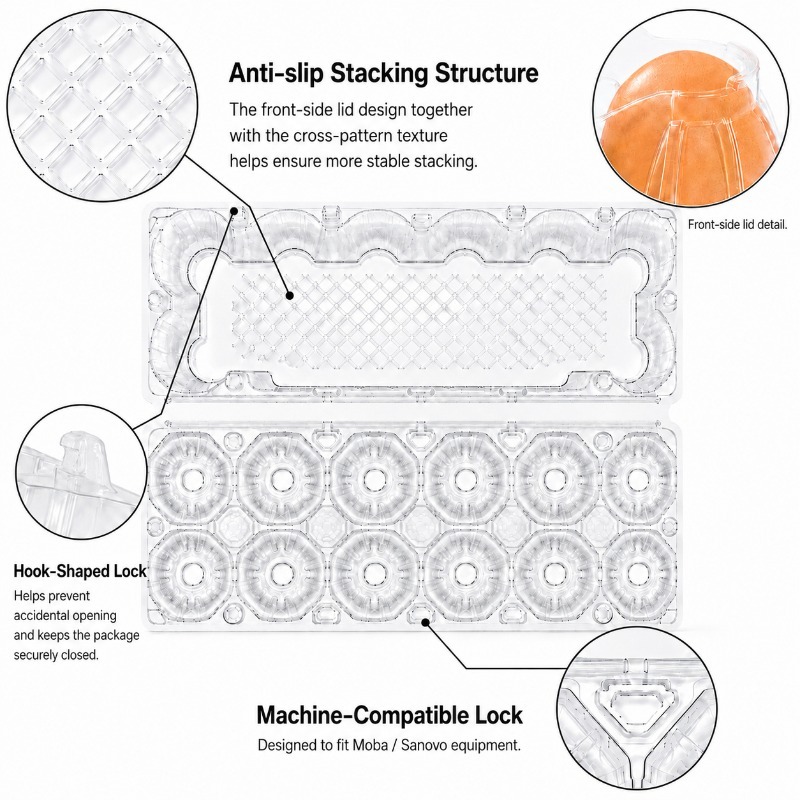
Each egg in a well-designed PET tray sits in a fully enclosed pocket that isolates it from neighboring eggs. The partition walls rise high enough that even if the tray is jostled violently, shells never strike one another. Egg-to-egg contact is one of the primary causes of star cracks during rough handling, and eliminating that contact removes a major breakage vector. When you examine a PET egg packaging for poultry farms under magnification, you will often notice micro-ribs inside each cavity that gently grip the shell, distributing pressure evenly and preventing rotation. This feature becomes critically important when eggs are transported on inclined conveyors or when cases are tilted during manual unloading. Instead of relying on a friction fit that changes with humidity, the engineered geometry of PET egg packaging for poultry farms provides consistent retention in all conditions.
Energy-Absorbing Structures Designed for Impact Protection
Beyond isolating eggs from each other, a superior tray needs to protect them from forces coming from outside the package. Modern PET egg packaging for poultry farms integrates a network of shock-absorbing legs, arches, and crumple pillars under each cavity. When a case is dropped from a tailgate or knocked against a pallet wrapper, these structures compress momentarily, increasing the duration of the impact pulse and thereby reducing the peak force transmitted to the egg. Is this level of engineering truly necessary for a humble egg tray? Poultry farms that ship high-value specialty eggs, organic free-range eggs, or thin-shelled heritage breed eggs quickly discover that the answer is a resounding yes. The difference in claim rates between generic trays and purpose-designed PET egg packaging for poultry farms can be stark, often paying back the packaging investment within a few shipping cycles.
Crystal-Clear Material for Visual Inspection Without Handling
One of the most underappreciated benefits of transparent PET is the ability to conduct a complete visual quality check without opening the package. A retailer can scan for cracks, blood spots, or dirt on every egg in seconds simply by rotating the sealed pack. Have you considered how many eggs are accidentally broken during the inspection process itself? When a quality controller or a customer picks up an egg to candle it, they introduce another handling step that carries a small but cumulative risk of dropping or knocking the egg against a hard surface. With PET egg packaging for poultry farms, eggs can remain undisturbed in their protective cavities while light passes cleanly through the material. This accelerates grading workflows and gives buyers confidence that they are purchasing an intact, clean product. For farm-direct sales at farmers’ markets, the clarity also serves as a powerful merchandising tool that showcases the rich shell color and uniformity of your flock’s production.
Interlocking Design That Maintains Stack Integrity
Stacks of egg trays often fail not because the material collapses but because layers slide sideways under vibration, allowing trays to cantilever out of alignment and concentrate weight on the rims of the eggs below. An effective solution is an interlocking rim system that registers each tray precisely onto the one beneath it. When a poultry farm selects PET egg packaging for poultry farms that features a positive-lock stacking lug, the entire column of trays behaves as a single unit. Side forces that would normally cause a tray to walk off its stack are transferred safely down the column into the pallet. This interlocking characteristic simplifies automation as well, because robotic denesters and palletizers can rely on consistent tray positioning without the need for vision systems to correct misaligned layers.
Standard Tray Configurations for Different Poultry Farm Operations
Comparing 12, 18, 20, 24, and 30-Egg PET Trays
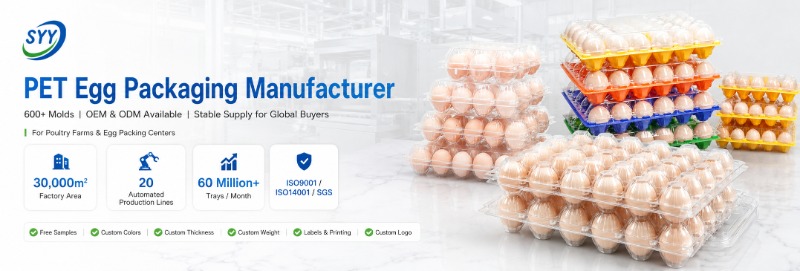
The optimal tray configuration depends entirely on how the eggs are sold and who the end customer is. A 12-egg PET tray is the classic retail format found in supermarket chilled cabinets, and it offers the smallest footprint for consumers with limited refrigerator space. An 18-egg tray appeals to medium-sized households and strikes a balance between portion size and packaging cost per egg. The 20-egg configuration often serves club stores and discount retailers where a slightly larger pack size signals value. For food service operators and bakeries that go through high volumes, 24-egg and 30-egg trays reduce the frequency of reordering and minimize packaging waste per egg. When a poultry farm evaluates PET egg packaging for poultry farms across these sizes, it must weigh the breakage risk associated with heavier trays against the labor savings of handling fewer units per thousand eggs. Heavier loaded trays demand thicker walls and reinforced corner posts, which some manufacturers of PET egg packaging for poultry farms address with graduated material distribution that puts more polymer precisely where structural stress concentrates.
How to Select Tray Capacity Based on Egg Grade and Customer Profile
Egg size and grade dictate which tray capacity will deliver the lowest damage rate. Jumbo and extra-large eggs place higher point loads on cavity floors and require a tray designed with deeper pockets and more generous spacing, which is often found in 20-egg or 24-egg configurations where the eggs are arranged in a staggered pattern rather than a tight grid. Medium and pullet eggs, by contrast, can fit comfortably in high-density 30-egg PET trays without risking shell-to-shell contact. What about the customer profile? A farm that supplies a white-tablecloth restaurant presenting eggs tableside will likely need a beautifully finished 12-egg PET tray that can go directly to the dining room, while a farm filling institutional contracts for school breakfast programs may find that the material efficiency of a 30-egg PET egg packaging for poultry farms format aligns better with the buyer’s sustainability and cost targets. Aligning tray capacity to egg grade and channel is one of the fastest ways to eliminate returns.
Procurement Considerations for Consistent Breakage Reduction
Egg Size Variability and the Importance of Proper Cavity Fit
No flock produces perfectly uniform eggs every day, and seasonal changes in daylight and temperature shift the size distribution curve. Ordering PET egg packaging for poultry farms with a generic “large egg” pocket can lead to a high breakage rate when the flock begins laying at the upper end of the large grade or when a new hybrid enters the production cycle. Why leave that fit to chance? Ask potential suppliers for cavity dimensional drawings that specify the minimum and maximum egg diameters and heights the tray can accommodate without compromising grip or risking shell contact. Farms with multiple breeds or mixed-age flocks often find that keeping two cavity profiles of PET egg packaging for poultry farms in inventory — one for medium-to-large and one for extra-large-to-jumbo — pays for itself through lower packing-line rejections and fewer customer claims.
Transport Distance, Mode, and Packaging Resilience
A tray that performs flawlessly on a fifty-mile delivery to a local grocery chain may not hold up during a five-hundred-mile journey over mountain passes in a less-than-truckload shipment where cases are transferred between multiple cross-docks. The longer the transport chain, the greater the cumulative exposure to vibration, drops, and atmospheric changes. When shipping distance exceeds two hundred miles, farms should specify PET egg packaging for poultry farms that has been tested to ISTA or ASTM transport simulation protocols, confirming that the tray and outer case can survive the specific hazards of the route. What about air freight for premium eggs sold internationally? The low-pressure environment of an aircraft cargo hold can cause sealed PET packages to expand and contract, so vented designs that equalize pressure without admitting contaminants become essential. Matching the PET egg packaging for poultry farms to the transport mode eliminates surprises at the destination.
Warehouse Stacking Requirements and Pallet Configuration
A high-density warehouse with narrow aisles and tall racking places demands on packaging that a small walk-in cooler does not. Before ordering, map out how many layers of filled trays will sit on a standard pallet and calculate the static load that the bottom tray must bear for potentially weeks at a time. Many farms discover that switching from a four-way entry pallet to a two-way entry pallet changes the bending forces on the lowest trays and necessitates a different wall thickness in the PET egg packaging for poultry farms they select. Additionally, the footprint of the tray should align with the internal dimensions of the reusable plastic crate or corrugated master case to prevent excessive lateral movement that leads to scuffing and abrasion of the outermost eggs. Specifying the complete pallet-and-tray system as an integrated unit, rather than sourcing trays in isolation, is a discipline that reduces transit damage by a measurable margin.
Matching Packaging Presentation to Retail or Wholesale Channels
The customer who selects a dozen eggs from a brightly lit refrigerated display is making a split-second judgment based on appearance. A PET egg packaging for poultry farms that arrives scuffed, cloudy, or distorted from heat exposure during a previous transport cycle will undermine the premium image a farm has spent years building. For retail, look for PET grades with high clarity retention and UV blockers that prevent yellowing under fluorescent lights. A label-friendly flat top surface that accepts pressure-sensitive stickers without obscuring the eggs is another feature that retailers value. On the wholesale side, where the tray will be removed and reused, durability takes precedence over optical perfection. In both cases, verifying that the PET egg packaging for poultry farms is compatible with the customer’s automated filling and labeling equipment prevents costly line stoppages and ensures a smooth, continuous packing operation from farm to consumer.
Steps to Receive a Customized PET Egg Packaging Recommendation
Key Parameters to Share With a Packaging Advisor
When you reach out to a specialist, provide them with the average weight and dimensional range of your eggs over a rolling twelve-month period, not just the nominal grade. Include details about your washing, grading, and packing line speed, because high-speed lines require trays with different denesting characteristics and dimensional tolerances than manual packing stations. Describe your typical pallet load: the number of layers, the type of interlayer sheets used, and whether stretch wrap or strapping is applied. The more specific you are about your distribution environment — refrigerated versus ambient, direct store delivery versus distribution center cross-docking — the more precisely a PET egg packaging for poultry farms recommendation can be tailored to your real-world conditions. Farms that share photos or videos of their current breakage points often receive the most actionable advice.
Evaluating Samples and Conducting a Breakage Trial
Before committing to a production order, request sample trays in the recommended cavity profile and conduct a controlled trial shipment. Load a pallet with eggs packed in your current packaging and an identical pallet using the proposed PET egg packaging for poultry farms, then send both through your most demanding delivery route. Document the condition of every egg upon arrival, photographing any cracks, and weigh the total loss. Compare not only the percentage of breakage but also the nature of the damage: is it catastrophic yolk-leaking breakage or superficial checking that still renders the egg unmarketable? This side-by-side trial generates hard data that justifies the packaging investment to stakeholders and reveals any fine-tuning needed in cavity size or tray gauge. Share your trial findings and egg specifications with a packaging engineer who can recommend the optimal PET egg packaging for poultry farms configuration for your operation.
Frequently Asked Questions About PET Egg Packaging for Poultry Farms
The primary advantages of PET egg packaging over traditional pulp and polystyrene trays
PET egg packaging for poultry farms delivers a combination of clarity, moisture resistance, and structural integrity that traditional materials cannot match. Pulp trays absorb humidity and lose compressive strength during refrigerated transport, while polystyrene foam can compress permanently after a single impact, creating loose cavities that no longer hold eggs securely. PET does not absorb water, maintains its mechanical properties across a wide temperature range, and provides complete transparency so that eggs can be inspected without removal from the protective pocket. This visual access significantly reduces handling-related breakage at grading stations and retail displays. In addition, the inherent toughness of PET allows thinner, lighter trays to carry the same load as heavier pulp equivalents, reducing transport weight and the associated carbon footprint of outbound shipments.
Cleaning and sanitizing procedures for reusing PET egg trays in closed-loop systems
Poultry farms operating a reusable packaging program can wash PET egg packaging for poultry farms using commercial crate washers set to temperatures between sixty and seventy degrees Celsius with mild alkaline detergents. Because PET resists chemical degradation, the trays withstand repeated wash cycles without warping or becoming brittle. It is important to avoid abrasive brushes that could micro-scratch the cavity surface, as deep scratches can harbor biofilm. After washing, a sanitizing rinse with a food-safe peracetic acid solution followed by thorough drying ensures that the trays return to the packing line hygienically clean. Farms should inspect returned trays for cracked partitions or deformed stacking lugs and cull any that show signs of mechanical fatigue, as maintaining perfect cavity geometry is essential for breakage prevention.
Custom sizing options when the flock produces non-standard egg dimensions
Specialty and heritage breeds often lay eggs that fall outside the standard large and extra-large commercial sizes, making off-the-shelf trays a poor fit. Many suppliers of PET egg packaging for poultry farms offer cavity customization based on a farm’s specific egg dimensional data. By providing a sample of fifty to one hundred eggs measured for length and width at the equator, a farm can obtain a cavity profile that cradles the eggs with optimal grip without constraining the air cell end. This tailored approach is particularly valuable for farms marketing bantam eggs, double-yolk jumbos, or elongated Marans eggs, where a generic cavity either leaves damaging gaps or presses too tightly against the shell.
The expected service life and end-of-life recyclability of PET egg trays
A well-designed PET egg tray used in a managed return-and-reuse loop can complete dozens of cycles before losing the precise cavity definition required for safe transport. When the tray eventually reaches the end of its service life, PET egg packaging for poultry farms can be ground, washed, and reprocessed into new packaging or other PET products, making it a fully recyclable material in the established PET recovery stream. Many farms partner with their packaging supplier to take back worn trays and feed them into a closed-loop recycling system that produces next-generation trays with a high percentage of post-consumer content. This circular approach supports sustainability goals while ensuring a consistent supply of high-performance packaging that consistently protects the eggs from the nest to the table.
Send us your egg size and logistics needs to get a tray recommendation.
Table of Contents
- Packaging Decisions That Directly Impact Your Bottom Line
- Uncovering the Root Causes of Egg Damage in Transit
- PET Egg Packaging as a Comprehensive Loss-Reduction Solution
- Standard Tray Configurations for Different Poultry Farm Operations
- Procurement Considerations for Consistent Breakage Reduction
-
Steps to Receive a Customized PET Egg Packaging Recommendation
- Key Parameters to Share With a Packaging Advisor
- Evaluating Samples and Conducting a Breakage Trial
- Frequently Asked Questions About PET Egg Packaging for Poultry Farms
- Cleaning and sanitizing procedures for reusing PET egg trays in closed-loop systems
- Custom sizing options when the flock produces non-standard egg dimensions
- The expected service life and end-of-life recyclability of PET egg trays
- Send us your egg size and logistics needs to get a tray recommendation.